
I Had Learned What to Think. I Had to Learn How to Think.
On failing, trying again, and learning without an answer key.
I failed.
Not in the figurative sense. I actually failed.
I was in graduate school and had just completed my mock research proposal, an exercise meant to test whether I was beginning to think like an independent scientist. Apparently, I wasn’t. At least not yet.
Until then, I had been pretty good at school. Good enough to get into a PhD program. Good enough, I thought, to figure things out. I had moved to a different country after high school and learned how to survive, adapt and make my way in a place that wasn’t home. By then, I trusted that if I worked hard enough, I could usually find my way through something.
Then I failed my proposal.
It was hard. There was a lot wrapped up in getting to that point, including sacrifices that weren’t only mine. I knew that continuing in the program mattered for reasons beyond simply passing an academic requirement.
So I tried again.
Somewhere in preparing to repeat the proposal, I realized that I had misunderstood something pretty fundamental about what I was there to learn.
I had spent years learning what to think. A PhD was asking me to learn how to think.
There is a difference.
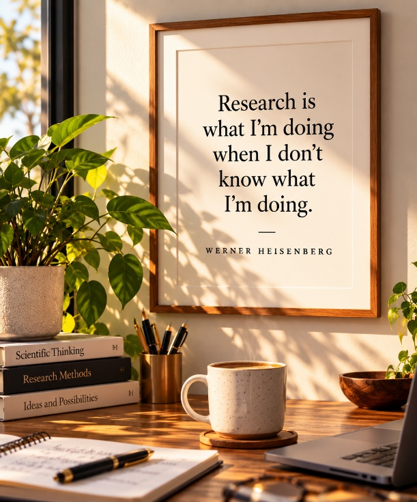
For most of my education, there had been an answer somewhere. I might not have known it, but somebody did. Research was different. The whole point was that the answer didn’t exist yet. I had to learn how to look at what was known, figure out what was missing, ask better questions and decide how I might find an answer.
Sometimes I was going to be wrong, and that was hard.
Years later, I don’t remember every detail of that proposal, but I remember the shift in how I thought. Strangely, that lesson has probably been more useful outside graduate school than I could have understood at the time.
Because life has very few answer keys.
We can research. We can read. We can ask people who have been there before us. I do all of those things.
But eventually we come across questions where nobody can tell us the answer.
At some point, gathering more information stops being the same thing as making a decision. You have to take what you know, acknowledge what you don’t, and think.
Failing my proposal didn’t feel useful when it happened. It just felt awful.
I think distance has a way of adding meaning to things. We look back and find the lesson, the turning point, maybe even the thing we’re grateful for. But while we’re actually living through it, sometimes it just feels awful.
It took me time to understand what that particular failure had given me.
Maybe learning how to think isn’t about always having the answer. Maybe it’s about getting more comfortable asking better questions, sitting with what you don’t know, and moving forward anyway.
Learning how to think is sometimes also about learning to trust your ability to think, even in the face of apparent failure.
That’s a revision I’ve carried with me long after graduate school.
Not learning to have all the answers. Learning what to do when I don’t.
So, a few questions I’ve been thinking about:
When you don’t know what to do, do you actually need more information, or are you hoping more information will make the decision for you?
Is there something you once considered a failure that you understand differently now?
What has failure taught you that success probably couldn’t have?
Leave a Reply