
Author: admin

  • You Can Still Be Warm, but You Have to Carry the Warmth With You

    Fall

    It’s absolutely absurd, but also apparently necessary, that we declare one day as the start of a season—or the end of one, for that matter. I suppose it helps us feel like there is order in the world. But realistically, seasons change all at once and gradually at the same time. Much like life, everything changes and yet somehow remains the same.

    Fall…or autumn, for those who prefer the fancier version is by far my favorite season. I say that every fall-until spring arrives, and I allow myself to change my mind every single time. But if you ask me, fall indeed is the most magical time of the year. It’s marked by the turning of leaves in a dazzling display of colors, all before they carpet the ground in one final display.

    I often wonder if trees feel sad as their leaves fall, or if they’re happy to be building the capacity to last through winter. This, admittedly, is less of a revision than a transition, but biologically, it does require a rewiring.

    I’ve learned to cherish the fall—and brace for winter.

    As much as I love fall, it also reminds me of something we learned very early on in elementary school: Make hay while the sun shines. The time to build capacity hasn’t completely passed, but the days are getting shorter, and the time to store energy for winter is running out. In a way, fall is a celebration of the hard work of preparation you’ve done.

    My grandfather had a plaque in his living room that read, “Dzidzai, Sevenzai, Nhamo Ichauya.” In Shona, it literally translates to “Learn, work, trouble will come.”

    In a way, it can seem rather grim…a warning of tough times ahead. But I’ve always taken it to be a promise. A promise that, indeed, tough times will come, but the fact that you’re able to read this plaque means you have a chance to learn, to work, to prepare.

    I do wish the transition to the winters of life came with a similarly beautiful final display. Often, it’s an abrupt pivot or downturn, with little warning. Sometimes it’s the loss of a job, a child, a parent, a friendship, or simply an unmistakable lightbulb moment that changes your thinking forever. Other times, it’s the shortening of days or a lingering, chillier breeze—a harbinger of tougher times ahead.

    But on the other side, sometimes hope—or a change of luck—comes just as suddenly, often through someone we never imagined we’d cross paths with.

    In those moments of change, it helps to think about how we might brace for the winters of life—to arrange and rearrange our resources, and let what we no longer need fall away.

    Questions I often ask myself:

    What am I carrying with me to help me last through winter?

    Is there anything I’m carrying that’s useless but taking up space? Empty peanut shells that look full but hold no promise of reserves? Words spoken years ago that shaped an identity we once lived in, but now take up more space than they’re worth?

    What can I delight in now to remind me of the warmth of summer, which will undoubtedly come?

    How do I live as the revision unfolds-slowly, but clearly headed for the cold before spring arrives?

    It’s easy to love spring, with the sunshine striking your skin and bringing natural warmth. Fall is different. You can still be warm, but you have to carry the warmth with you.

    Much like in life, during the fall or winter seasons, you carry the warmth inside your soul or find it in a cozy fire, a warm sweater, or my favorite—a beloved poncho. Sometimes, it comes from a good friend with a listening ear, a simple word of encouragement, or someone willing to just sit beside you and share their warmth.

    But the fact remains that extra energy is needed in the fall and winter seasons of life. It doesn’t mean anything is wrong with you, but it does take more out of you. Perhaps that’s something worth remembering when we find ourselves more tired than usual, or when the things that once came easily suddenly require a little more effort.

    And yet, in every season, every single day has a sunrise and a sunset. Even in winter, there are moments of warmth, sometimes in the most unexpected places. Perhaps the point isn’t to spend the fall dreading the winter, but to find something worth appreciating in the season we’re in.

  • Life Rarely Follows the First Draft

    On changing a plan that wasn’t necessarily wrong.

    Three years ago, I boarded a plane headed somewhere farther than I had ever been in the U.S. I love to travel, but this felt different.

    I had heard the city was beautiful, and I was excited to see it, but I remember sitting on that plane with this strange feeling that I might actually be choosing between the life I knew and a completely different one. The funny thing was, I didn’t even know if I had the job yet.

    I was going to check out the city while I waited to hear back, which meant I was running through all of these scenarios for a decision that technically wasn’t even mine to make yet. What if I got it? Would I actually go? What would I do if I didn’t? Would I be disappointed or relieved?

    I consider myself a pretty spontaneous person. I love to travel. I don’t need every weekend planned out. But I’ve realized there is a difference between being spontaneous and being comfortable with your life being unstructured. My life had generally followed a structure. School, graduate school, training, work. There was usually a next thing, even when I didn’t know exactly how it would work out.

    This didn’t feel like that.

    One of the things I kept coming back to was the house. Saved for years to buy a house and lived in it for barely six months.

    Six months.

    I think about that even now because it was one of my first big lessons in how little life cares about the timeline you had in your head. You can spend years saving for a house and then barely get to live in it.

    And the strange thing is, there was nothing wrong with the house. I loved it. Buying it wasn’t a mistake. But another option had appeared.

    At the time, I thought I was deciding whether I was willing to leave a house, a city and a life I knew for something much less certain. Looking back, I think there were probably more things wrapped up in that decision than I understood at the time.

    And maybe that’s part of why some decisions feel so difficult. Every revision seems to come with a price.

    It’s one thing to change direction when something clearly isn’t working. But what about when you’ve worked really hard for the life you have? When you’ve invested money, time, relationships, years? What do you do when you’re not choosing between something bad and something good, but between something you know and something you don’t?

    I still don’t think I’m someone who can just “take the leap” and not think about it. I will probably always think about the consequences. I’ll probably always run through more scenarios than necessary. I’m learning that this isn’t necessarily a bad thing.

    But I’ve also realized that I can think something through a hundred different ways and still not know for sure. Sometimes you just don’t have all the information. And no amount of thinking is going to give you information you don’t have yet. You make the decision with what you know at the time, and three years later you may look at that same decision completely differently.

    I still want to know what something will cost before I choose it. I still find it difficult to walk away from something I’ve invested time, money or years of my life into. But I’m getting more comfortable with the idea that not every decision will come with enough information to make me feel certain.

    So if you’re somewhere in the middle of a revision yourself, these are a few questions I’ve been thinking about:

    Am I holding onto this because I still want it, or because of how much it took to get here?

    What would changing direction actually cost me? And what might it cost me to stay?

    Am I waiting for information I can realistically get, or am I waiting for a level of certainty that doesn’t exist?

    If I knew I wouldn’t be embarrassed about changing my mind later, would I make the same choice?

    And if this doesn’t turn out exactly as I hope, does that automatically mean it was the wrong decision?

    I don’t think the point is to become someone who makes big decisions without thinking them through. That’s certainly not who I’m becoming. Maybe I’m just learning that being thoughtful about a decision doesn’t mean I have to be certain about it.

    And maybe that’s part of learning to live with revisions. Some of them will make sense immediately. Others might take years before you understand what they changed, or why you needed them in the first place.

    Three years ago, I got on that plane without knowing whether I would get the job, whether I would move, or what any of it would mean for the life I had already built. I didn’t know what came next.

    I just knew that, for the first time in a long time, I wasn’t quite sure what page I was going to land on.

  • I Had Learned What to Think. I Had to Learn How to Think.

    I Had Learned What to Think. I Had to Learn How to Think.

    On failing, trying again, and learning without an answer key.

    I failed.

    Not in the figurative sense. I actually failed.

    I was in graduate school and had just completed my mock research proposal, an exercise meant to test whether I was beginning to think like an independent scientist. Apparently, I wasn’t. At least not yet.

    Until then, I had been pretty good at school. Good enough to get into a PhD program. Good enough, I thought, to figure things out. I had moved to a different country after high school and learned how to survive, adapt and make my way in a place that wasn’t home. By then, I trusted that if I worked hard enough, I could usually find my way through something.

    Then I failed my proposal.

    It was hard. There was a lot wrapped up in getting to that point, including sacrifices that weren’t only mine. I knew that continuing in the program mattered for reasons beyond simply passing an academic requirement.

    So I tried again.

    Somewhere in preparing to repeat the proposal, I realized that I had misunderstood something pretty fundamental about what I was there to learn.

    I had spent years learning what to think. A PhD was asking me to learn how to think.

    There is a difference.

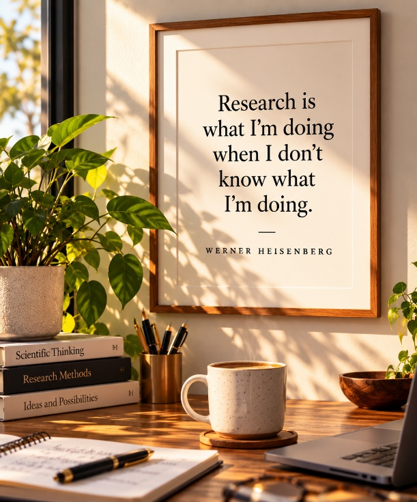
    For most of my education, there had been an answer somewhere. I might not have known it, but somebody did. Research was different. The whole point was that the answer didn’t exist yet. I had to learn how to look at what was known, figure out what was missing, ask better questions and decide how I might find an answer.

    Sometimes I was going to be wrong, and that was hard.

    Years later, I don’t remember every detail of that proposal, but I remember the shift in how I thought. Strangely, that lesson has probably been more useful outside graduate school than I could have understood at the time.

    Because life has very few answer keys.

    We can research. We can read. We can ask people who have been there before us. I do all of those things.

    But eventually we come across questions where nobody can tell us the answer.

    At some point, gathering more information stops being the same thing as making a decision. You have to take what you know, acknowledge what you don’t, and think.

    Failing my proposal didn’t feel useful when it happened. It just felt awful.

    I think distance has a way of adding meaning to things. We look back and find the lesson, the turning point, maybe even the thing we’re grateful for. But while we’re actually living through it, sometimes it just feels awful.

    It took me time to understand what that particular failure had given me.

    Maybe learning how to think isn’t about always having the answer. Maybe it’s about getting more comfortable asking better questions, sitting with what you don’t know, and moving forward anyway.

    Learning how to think is sometimes also about learning to trust your ability to think, even in the face of apparent failure.

    That’s a revision I’ve carried with me long after graduate school.

    Not learning to have all the answers. Learning what to do when I don’t.

    So, a few questions I’ve been thinking about:

    When you don’t know what to do, do you actually need more information, or are you hoping more information will make the decision for you?

    Is there something you once considered a failure that you understand differently now?

    What has failure taught you that success probably couldn’t have?